Raster · 01.4
SuperPaint
Richard Shoup's system at Xerox PARC was the first that let a person paint into a framebuffer and see it immediately.
In this entry
- The first machine that let you paint light
- The hardware Shoup had to build
- What the system could do
- Colour as a design problem
5 parts · Raster 01.4
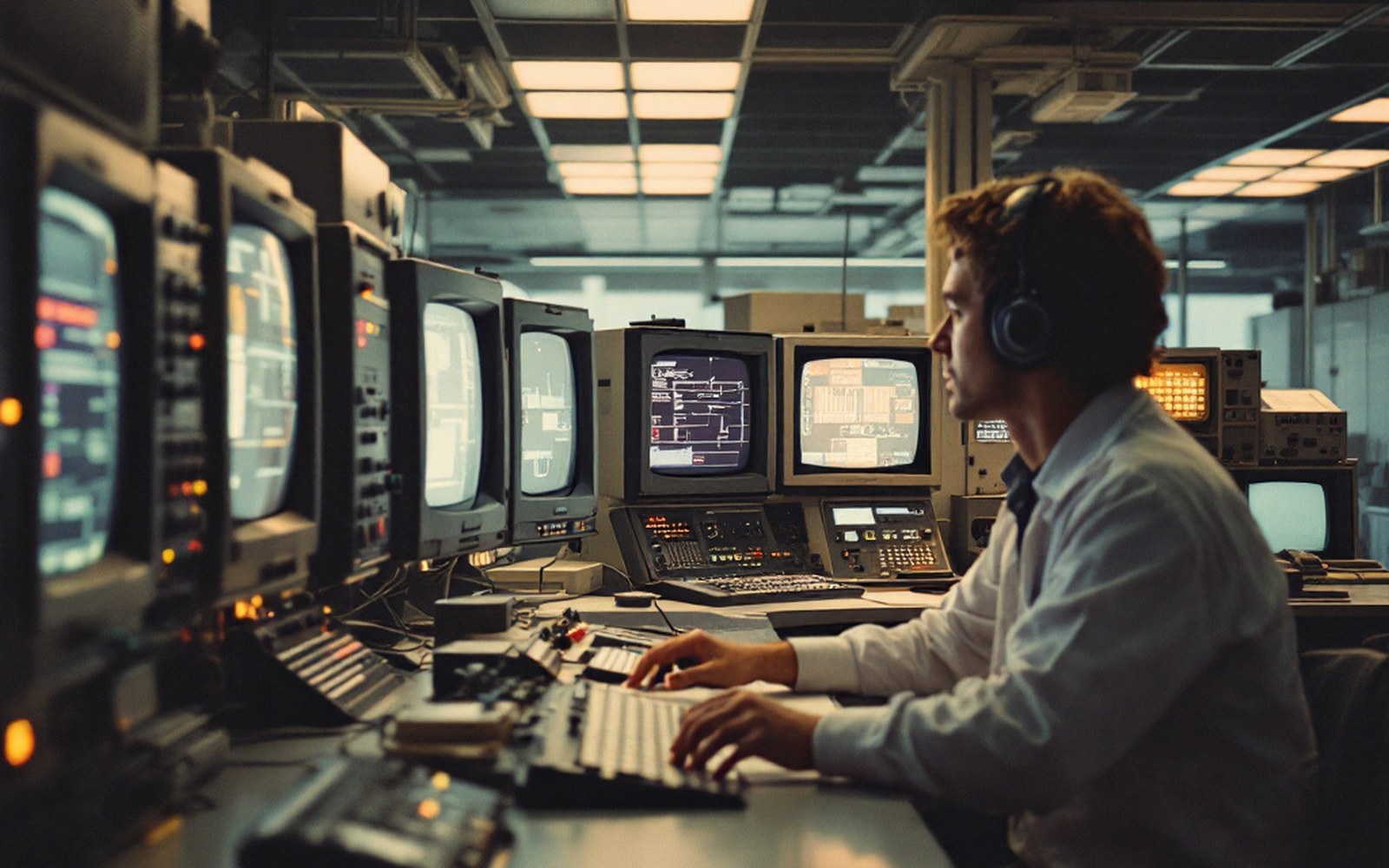
Photo: RazorArt asset kit
The first machine that let you paint light
Richard Shoup built SuperPaint at Xerox PARC in Palo Alto, California between 1972 and 1973, and it was the first system in which a person could pick up a stylus, move it across a tablet, and watch colour appear on screen in real time — not lines approximated on a vector display, not a diagram updated in discrete steps, but paint, flowing into a framebuffer pixel by pixel as fast as the hand moved. Everything built since, from the earliest commercial paint programs to the tools in use today, descends from the architecture Shoup assembled in that building.
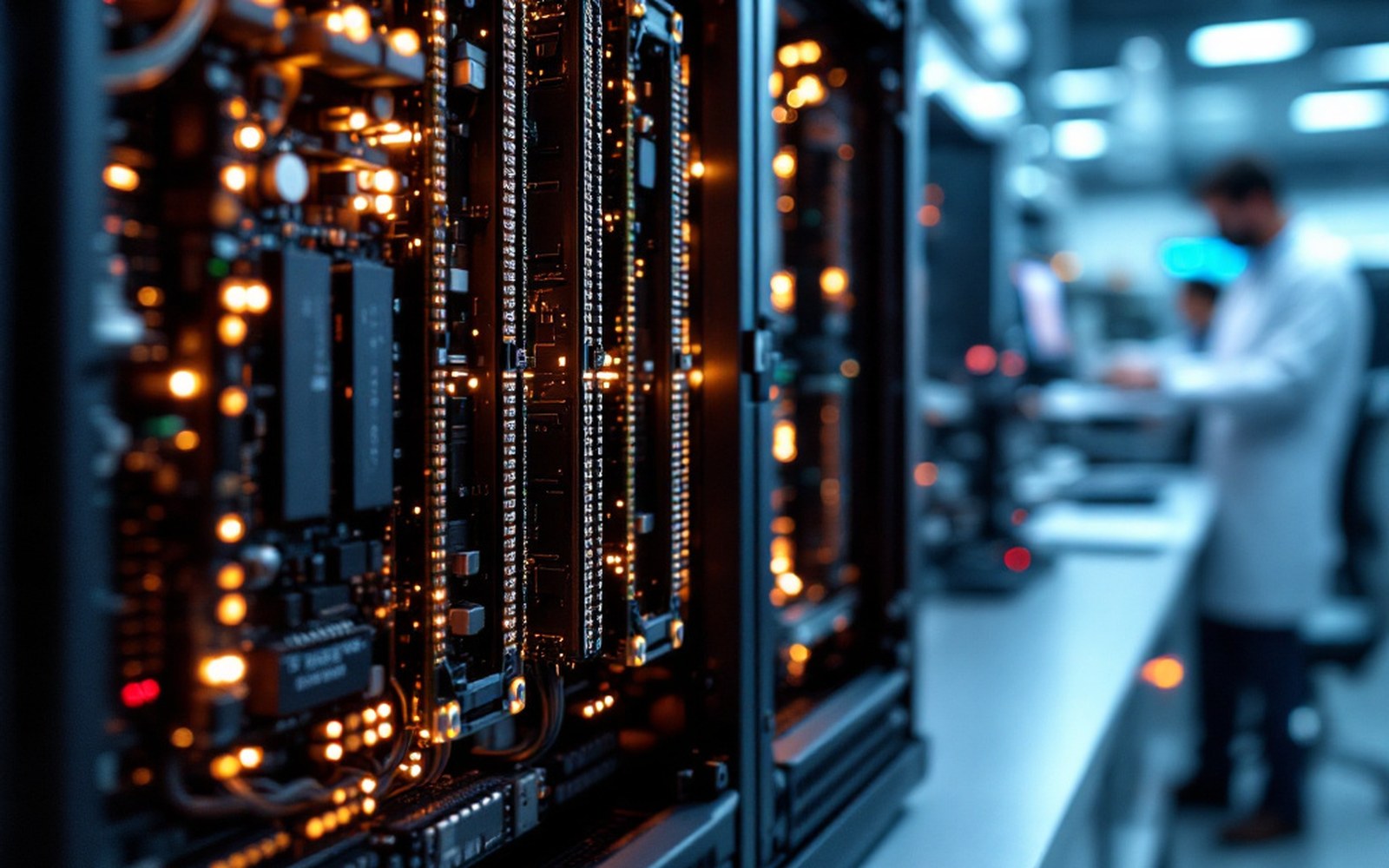
To understand why SuperPaint mattered, you have to understand what was missing before it. Vector displays could draw precise lines and curves by steering an electron beam, but they held no image in memory — every line had to be redrawn many times per second from a list of coordinates, and there was no way to represent filled areas, gradients, or the kind of mark a brush makes. What Shoup needed instead was a framebuffer: a dedicated block of memory in which each pixel has its own address and a stored value that the display reads once per frame. Framebuffers existed in research contexts before 1972, but they were expensive, slow to write, and typically monochrome. Shoup designed and built a custom framebuffer for SuperPaint that stored eight bits per pixel — enough to index a table of 256 colours — and that a program could write to fast enough that the screen updated without perceptible lag.
The hardware Shoup had to build
Eight bits per pixel sounds modest, but it was a deliberate and elegant choice. The framebuffer itself stored indices, not colours; the actual colour values lived in a separate lookup table, a piece of hardware Shoup called the colourmap. Change an entry in the colourmap and every pixel carrying that index changed colour simultaneously, across the whole screen, in one frame. This meant that colour cycling — animating a palette without repainting the image — was an intrinsic property of the architecture, not a trick. It also meant that the same framebuffer could display radically different colour relationships by swapping the table, which gave Shoup and the artists who later used the system a degree of colour control that no previous interactive system had offered.
The input side of the system was a digitising tablet — the lineage of which runs through the RAND Tablet, which had demonstrated as early as 1964 that a stylus position could be read electronically and precisely. Shoup's tablet fed X and Y coordinates into the system continuously. A dedicated minicomputer (a Data General Nova) read those coordinates, applied the current brush shape and colour selection, and wrote the result into the framebuffer. The loop from stylus to screen was fast enough that the delay was not obvious to a human painter — the system felt, to anyone who used it, like drawing on the display surface directly.
The display itself was a modified broadcast-standard colour television monitor, chosen in part because the colour television infrastructure of the early 1970s provided a known, calibrated chain from voltage levels to phosphor emissions. That choice was consequential: SuperPaint operated in a colour space tied to the phosphors of the NTSC broadcast standard, which meant its colours were measured and repeatable within that standard's gamut. Shoup was thinking about colour as a property to be controlled, not merely produced.
What the system could do
SuperPaint offered tools that are now so familiar they feel inevitable: a freehand brush with adjustable size, a fill operation that flooded a bounded region with colour, zoom that let a user paint individual pixels, and copy-paste operations that could move regions of the image. None of these were inevitable in 1973. Each required Shoup to solve a concrete algorithmic problem — flood fill in particular, which must decide which pixels are inside a boundary without overflowing it, is a non-trivial graph-traversal problem, and Shoup's implementation was among the earliest in an interactive painting context.
The system also supported a form of image processing: a painted image could be passed through operations that modified pixel values mathematically — brightening, inverting, blending one image into another. Shoup thought of the framebuffer not just as a canvas but as a signal, something that could be processed the way an audio engineer processes sound. This framing — image as data, not just picture — was part of what made SuperPaint a research instrument rather than merely a creative tool.
Artists were invited to use SuperPaint during its development at PARC, and some of the work produced on the system demonstrated that a framebuffer-based painting tool was useful to people who were not engineers. That practical validation mattered. Shoup and PARC presented the work publicly, and ACM SIGGRAPH became the venue through which the technical details reached the wider computer graphics community. The 1979 SIGGRAPH paper by Shoup remains the principal primary source on the system's design.
Everything built since, from the earliest commercial paint programs to the tools in use today, descends from the architecture Shoup assembled in that building.
Colour as a design problem
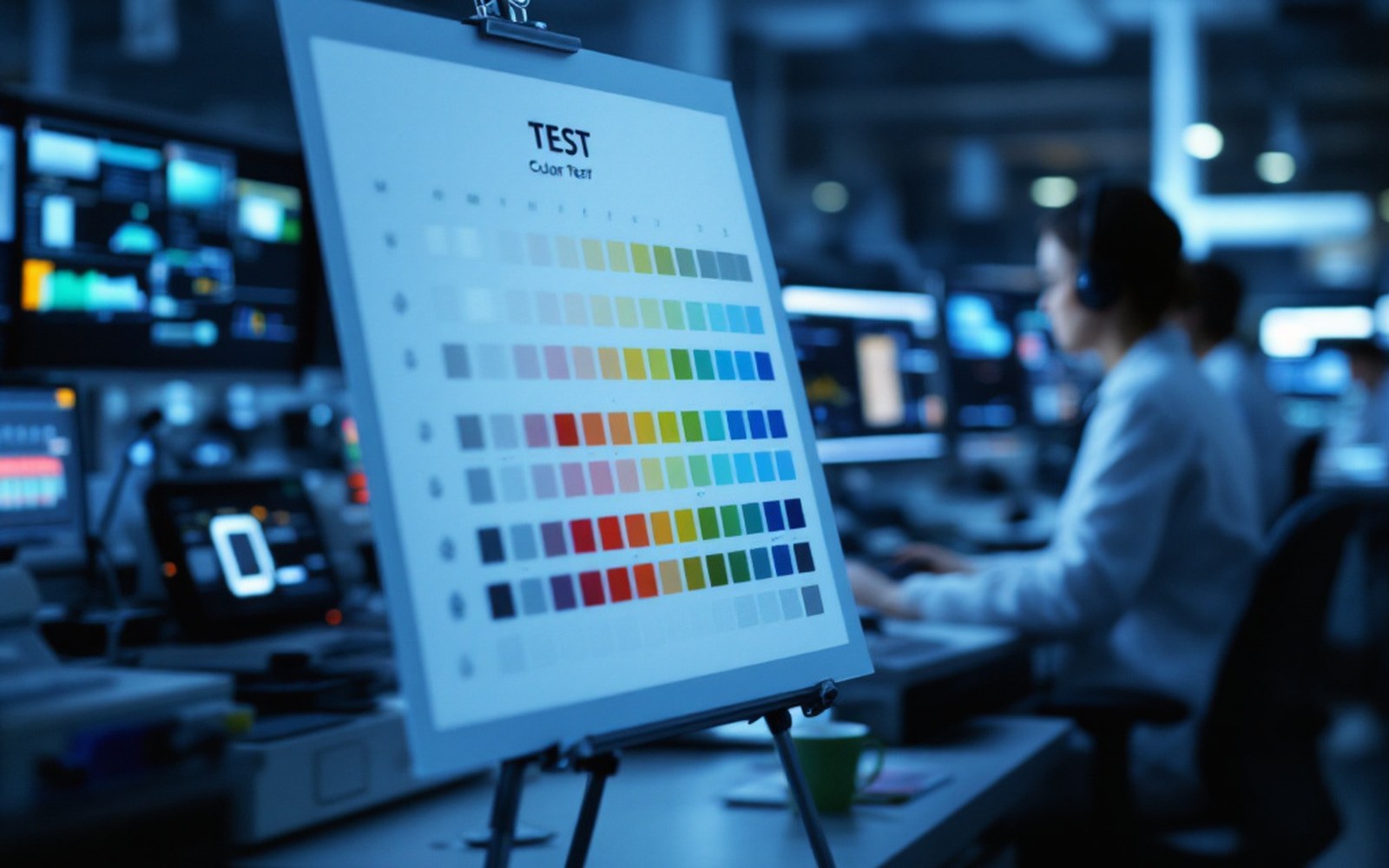
Shoup's attention to colour was unusually rigorous for its moment. The lookup table architecture gave the system colour flexibility, but it also forced Shoup to think carefully about how colour values in the table corresponded to colours a human eye would perceive. The Commission internationale de l'éclairage, which had published its foundational colour measurement framework in 1931, had established that human colour perception is not linear in the way that voltage levels are linear — equal steps in a colour space do not look like equal steps to the eye. Shoup's colourmap allowed the mapping between stored index and output voltage to be tuned, which was a primitive but real attempt to address perceptual non-linearity.
This concern connects SuperPaint to a larger problem that would occupy researchers for decades: how to represent colour in a way that is both computationally tractable and perceptually meaningful. Alvy Ray Smith, who worked at PARC shortly after Shoup and went on to develop HSV (hue, saturation, value) colour representation, was part of the environment that SuperPaint helped create. The system was not just a tool; it was a site where the questions that defined digital colour were first posed in practical terms.
The machine that preceded the industry
SuperPaint did not become a commercial product. Xerox, whose business was paper and copying machines, did not pursue the direction Shoup had opened, and the system remained a research artefact. Shoup received the Academy Award for Technical Achievement in 1998, shared with Alvy Ray Smith and others, in recognition of SuperPaint's foundational role — an acknowledgment that came a quarter century after the work, which is about the standard lag between a foundational invention and its formal recognition.
The architecture Shoup built — framebuffer plus colourmap plus fast stylus input plus a program that writes paint-shaped marks — is the architecture every raster painting application still uses. The framebuffer grew from eight bits to thirty-two. The colourmap gave way to direct colour. The Data General Nova gave way to processors fast enough to apply not just flat colour but pressure sensitivity, blending modes, and procedural textures in real time. But the loop is the same: move the instrument, write to memory, read memory to screen. Shoup closed that loop first.

Related in Raster