Instruments · 05.1
The RAND Tablet
An early digitising tablet that let a stylus position be read directly, years before anything like it was affordable.
In this entry
- A surface that could read a point
- From the laboratory to the drawing interface
- Why the mechanism persisted
3 parts · Instruments 05.1
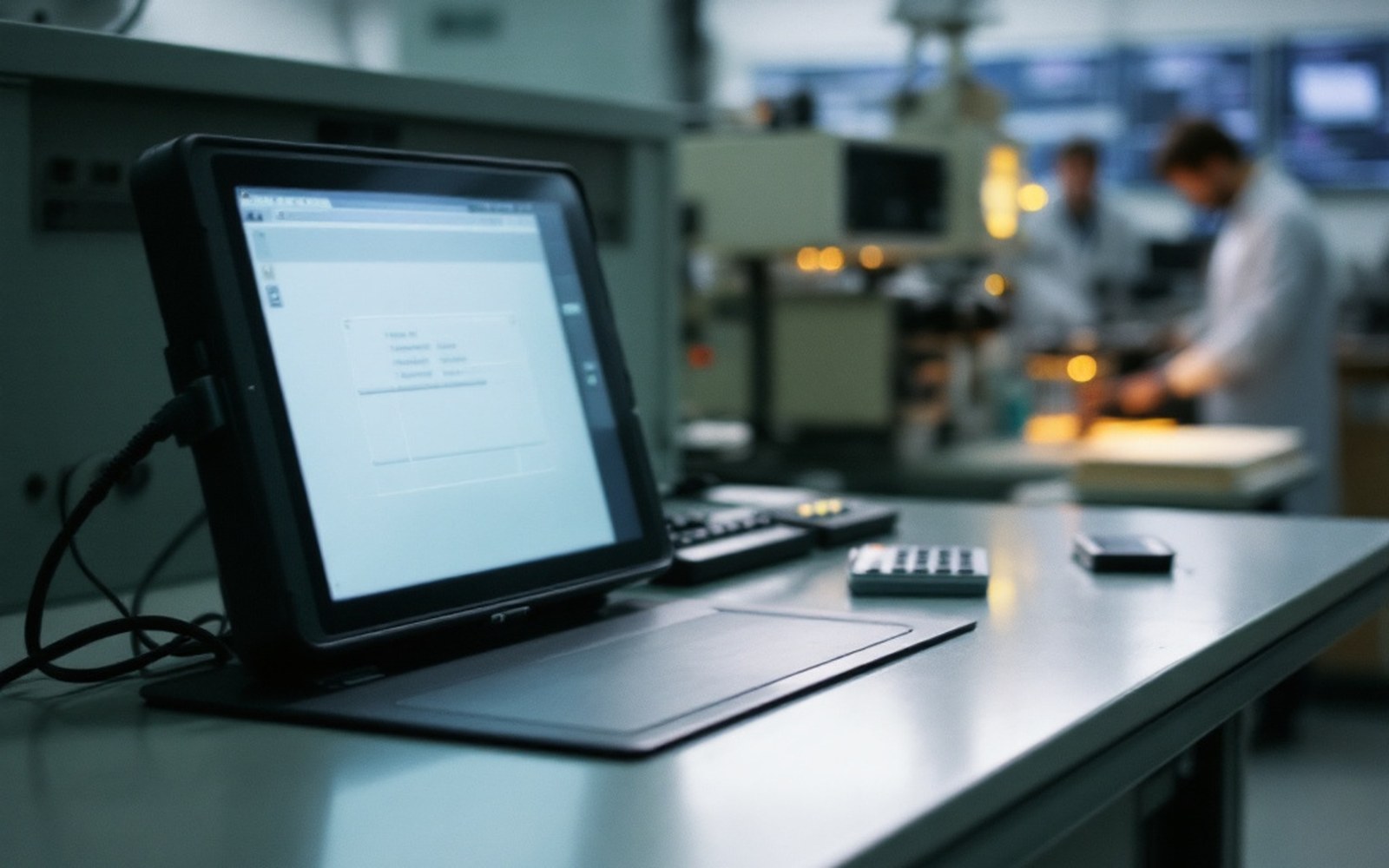
Photo: RazorArt asset kit
A surface that could read a point
In the years before digital drawing was a commercial proposition, the hardest problem was not the display — it was getting coordinates into the machine. A keyboard yields text; a dial yields a single value; a joystick yields direction. What a draughtsman needs is a surface, something that turns the natural act of pointing at a position into a pair of numbers the computer can use. The RAND Tablet, built at the RAND Corporation in Santa Monica, California in the early 1960s, was the first device to solve this problem in a form that others could actually study and copy.
The tablet emerged from a specific institutional pressure. RAND was running command-and-control research for the US Air Force, and its analysts needed to interact with maps and diagrams on screen — not by typing coordinates but by indicating them directly. The light pen was the obvious candidate, and RAND's own researchers had built light-pen interfaces on RAND 's Johnniac computer in the late 1950s. But the light pen is coupled to the display: it only reports a position when the scanning beam passes under its tip, which means it can only point at something already drawn on screen. A blank region of the picture is, to the light pen, invisible. What RAND needed was a device that could report any position on a surface, independently of what the screen was showing at that moment.

The solution, developed by M. R. Davis and T. O. Ellis and described in a 1964 RAND Memorandum, was a flat tablet approximately ten inches square, embedded with a fine grid of wires running in two perpendicular directions. A handheld stylus carried a sensitive pickup. The tablet's electronics pulsed coded signals through the wire grid in a timed sequence, and the stylus picked up the signals from the wires beneath its tip by capacitive coupling. Because the pulse timing was known and each wire in the grid carried its own distinct code, the tablet's circuitry could calculate the stylus position to a resolution of around one hundredth of an inch — roughly a hundred lines per inch across the whole surface. The position was reported as a continuous stream of coordinate pairs, not as a button press or a single event: the tablet was always reading.
This was a genuine departure. Earlier digitising approaches — tracing a cursor across a mechanical pantograph, or clicking a crosshair at vertices on a data tablet with discrete contact points — were either cumbersome or low-resolution. The RAND Tablet gave fluid, sub-millimetre tracking without requiring the user to press hard or align carefully. The stylus could hover slightly above the surface and still be read.
From the laboratory to the drawing interface
Ivan Sutherland had demonstrated at MIT Lincoln Laboratory in Lexington, Massachusetts that a computer could manipulate graphical objects drawn with a light pen, and his Sketchpad system of 1963 set out what interactive drawing might become. But Sutherland's light pen could only follow existing display content. The RAND Tablet offered a complementary and, for many tasks, superior input channel: a surface you could mark, trace or point at as if it were paper, regardless of what the computer happened to be showing.
RAND made the tablet available to other researchers, and it was taken up widely enough that "RAND Tablet" became a generic term in the human-computer interaction literature of the 1960s and early 1970s. Thomas Ellis published further technical documentation that allowed other institutions to build compatible devices. The tablet appeared in studies of handwriting recognition, in command-and-control interfaces, and eventually in early graphics workstations. When Douglas Engelbart's group at the Stanford Research Institute was cataloguing input devices in the mid-1960s — work that would eventually feed into the invention of the mouse — the RAND Tablet was one of the reference instruments against which other devices were measured.
In the years before digital drawing was a commercial proposition, the hardest problem was not the display — it was getting coordinates into the machine.
The tablet's most direct intellectual descendants in the graphics world came through the workstation research of the early 1970s. When Richard Shoup was building SuperPaint at Xerox PARC in Palo Alto, California — the system that first let someone paint continuously into a framebuffer — input from a stylus-based tablet was part of the interaction model from the beginning. The tablet let the system read position (where the stylus was); pressure sensing came later and in different hardware. What the RAND Tablet had established was the principle: a continuous, high-resolution, position-reporting surface is the right instrument for drawing.
Alvy Ray Smith, who worked on colour and painting systems in the years after Shoup, described the framebuffer and the input tablet as a matched pair — memory to hold the image, and a surface to accept the gesture. Neither was sufficient alone. The RAND Tablet had existed before affordable framebuffer memory was available, which is why it spent its first decade feeding coordinate data to line-drawing programs and character recognisers rather than to paint systems. Once Richard Shoup and the engineers at Xerox PARC had working framebuffer hardware, the tablet's role sharpened: it became the natural hand of the painting tool.
Why the mechanism persisted
The grid-and-stylus method the RAND Tablet introduced proved remarkably durable. Later commercial tablets — the Summagraphics BitPad of the 1970s, the Wacom devices that became standard equipment for digital illustrators from the 1980s onward — build on the same basic idea: a grid of conductors in the tablet body, a stylus or puck that couples to it, and circuitry to extract a precise position, even where the coupling method differs. The Wacom digitiser mechanism, which uses electromagnetic resonance so that the stylus needs no battery, applies a different coupling method to the same grid-beneath-the-surface idea RAND's engineers worked out in Santa Monica six decades ago.
What the RAND Tablet got right was the geometry of the problem. Any input device for drawing has to report two values — x and y — continuously, at a rate fast enough that the computer can keep up with a moving hand, and with enough resolution that the resulting coordinates do not look coarse on screen. A grid of wires beneath a flat surface, read by a stylus, satisfies all three requirements with no moving parts, no mechanical wear, and no dependency on where the display beam happens to be. The insight was modest stated plainly, but nothing equivalent had existed before, and digital graphics has not needed a fundamentally different answer since.

Related in Instruments