Drawing · 02.1
Sketchpad
The first interactive drawing program treated lines as objects you could name, move and constrain — and everything done on a screen since has inherited that idea.
In this entry
- A machine for thinking with geometry
- Constraints and instances
- What it changed, and how slowly
3 parts · Drawing 02.1
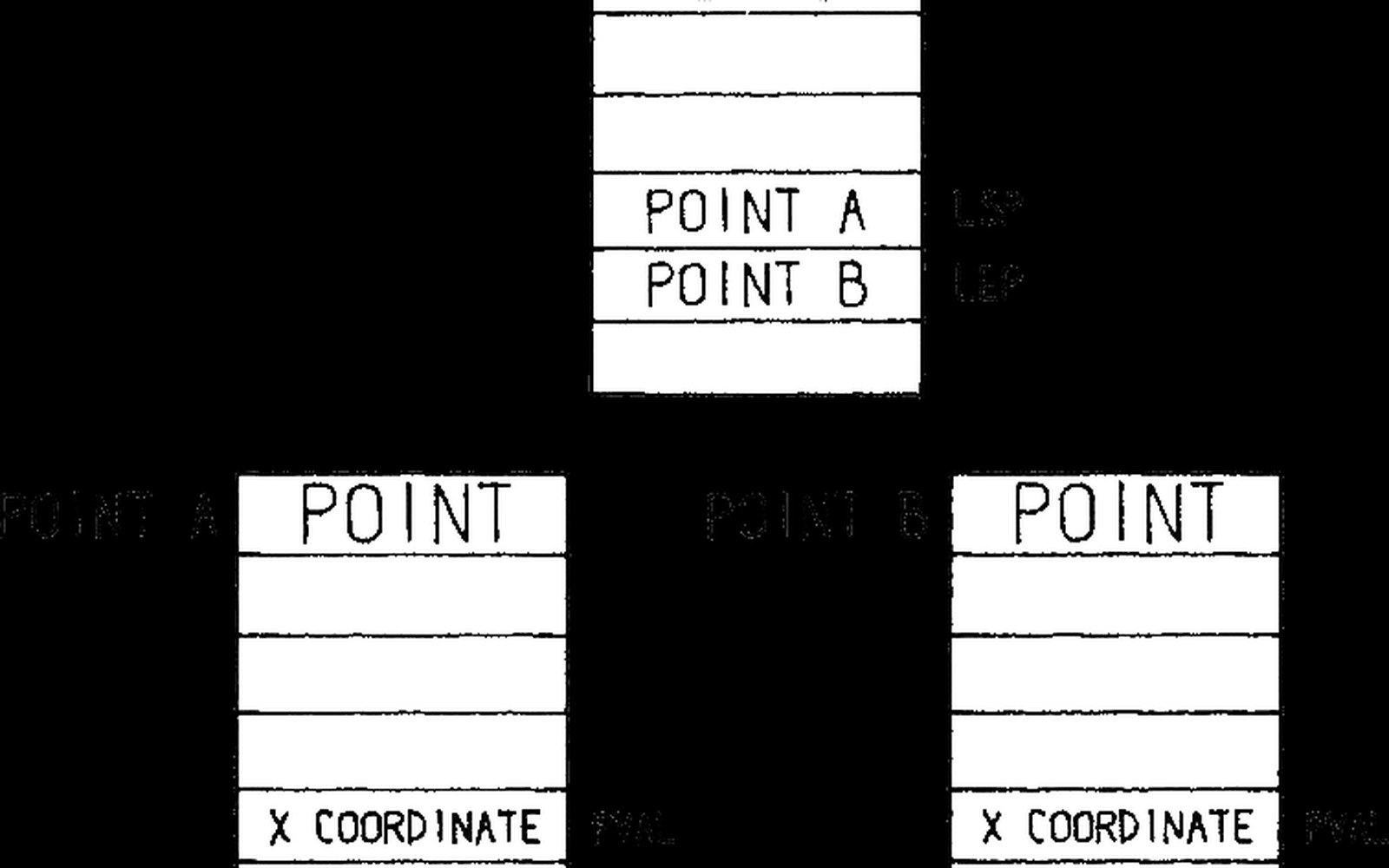
Photo: Sketchpad N-Component Element · Wikimedia Commons
A machine for thinking with geometry
In January 1963, Ivan Sutherland submitted his doctoral thesis to MIT and, almost as a footnote, demonstrated the system it described on a TX-2 computer at MIT Lincoln Laboratory in Lexington, Massachusetts. The demonstration was not a footnote at all. Sketchpad was, in any serious reckoning, the first interactive computer graphics program — the point at which a human being sat in front of a screen, held a light pen that detected the electron beam sweeping across the phosphor, and drew.
The TX-2 was a transistorised research machine with an unusually large memory for the time, which mattered enormously. Sketchpad had to store not just the image on the screen but a structured description of every geometric element in the drawing. That is the core idea: the drawing was not a grid of marks but a collection of objects, each with its own address, its own parameters and its own relationships to other objects.
A line in Sketchpad was not a smear of phosphor. It was an entity: two endpoints, a slope, a length that could be queried. A circle was a centre and a radius. When you moved an endpoint, the line updated; when you scaled a shape, its angles held or its sides shortened according to rules you had declared. The system Sutherland built distinguished, fundamentally and for the first time, between the description of a picture and the picture itself.
Constraints and instances
Two features of Sketchpad set it apart from every drawing system that followed, including the ones that eventually put it out of mind by the time personal computers arrived.
The first was constraints. Sutherland built a mechanism by which the user could declare geometric relationships — this line must be horizontal, these two lengths must be equal, this corner must be a right angle — and the system would enforce them. Move one part of the drawing and the constrained parts would follow. The mathematics behind this was a form of constraint satisfaction: a set of simultaneous equations that Sketchpad solved iteratively, using a relaxation method, each time the geometry changed. Telling a drawing what it must be rather than what it currently is remains one of the deepest ideas in computational geometry, and it is still the foundation of parametric CAD systems built decades later.
The second feature was instancing. Sketchpad allowed a user to define a shape — call it a master — and then place copies of it, called instances, anywhere in the drawing. Changing the master changed every instance. This is now so commonplace that it feels obvious: it is the symbol in a design application, the block in an engineering drawing, the component in a UI kit. In 1963 it was an invention. Sutherland described the relationship between master and instance in his thesis with a precision that reads today as a direct ancestor of object-oriented data structures.
The light pen itself deserves a word. It did not project light; it detected it. When the TX-2's cathode-ray beam swept past the pen's tip, a photoelectric sensor fired, and the timing of that signal told the computer exactly where on the screen the pen was pointing. Pointing at an existing element selected it; pointing at blank space and pressing the right control initiated a new element. The pen was fast — it read the screen at the screen's own refresh rate — and Sutherland designed Sketchpad's interface so that almost every operation needed only the pen and the buttons on the TX-2's light-pen stylus, not a keyboard.
The TX-2 was a transistorised research machine with an unusually large memory for the time, which mattered enormously.
What it changed, and how slowly
Sutherland's thesis was published formally through MIT and later reprinted by ACM SIGGRAPH as a historical document, which is itself a signal: the field eventually recognised that this was the founding text of interactive computer graphics. But the influence was not instant. The TX-2 was a one-of-a-kind research machine; Sketchpad could not be ported anywhere. What spread were the ideas, through people who had seen the demonstration or read the thesis.
Douglas Engelbart at the Stanford Research Institute read Sutherland's work and it informed the thinking behind his own augmentation research, which produced the mouse and the windowed interface — a different branch from the same root. The RAND Tablet, a digitising surface that RAND Corporation developed in Santa Monica, California, took a different approach to input, replacing the screen-tracking pen with a coordinate grid embedded in a flat surface. Richard Shoup's SuperPaint system at Xerox PARC in Palo Alto, California, worked with a framebuffer and was concerned with paint and colour rather than structured geometry; but the question of what kind of thing a drawing is — mark or object — runs through all of it.
The object model that Sutherland invented is what eventually became vector graphics in the modern sense: paths, nodes, handles, groups. Pierre Bézier, working at Renault in Boulogne-Billancourt, and Paul de Casteljau, working independently at Citroën, were developing the parametric curve mathematics that would give those objects their characteristic smooth shapes. Sketchpad itself used conic sections and straight lines; the Bézier formulation came a few years later. But the structural idea — a curve as an object described by control points, not as a sequence of pixels — is continuous with what Sutherland had built.
The pixel-based approach, the raster, won the consumer market because memory got cheap. By the time a desktop machine could hold a full framebuffer, painting in pixels was the natural model for photographic work. But structured, object-based drawing never went away; it retreated into specialised tools and then returned as those tools became universal. Every time a designer moves a node and watches a curve update, or links two elements so that resizing one resizes the other, the system is executing something Sutherland described in a document submitted for a doctorate more than sixty years ago. He called it Sketchpad. The field called it a thesis. It was, in practice, a proof of concept for nearly everything that came next.

Related in Drawing